Machine integration
Do you have control over disruptions to your production? Is your production optimal? Are your post-calculations reliable? Machine integration (MI) helps you improve your company's efficiency in production.
What is MI?
MI is a function which integrates your machines with Monitor ERP. This way the worked hours, quantity, and downtime are reported automatically. You also get a good overview of current status and OEE follow-up.
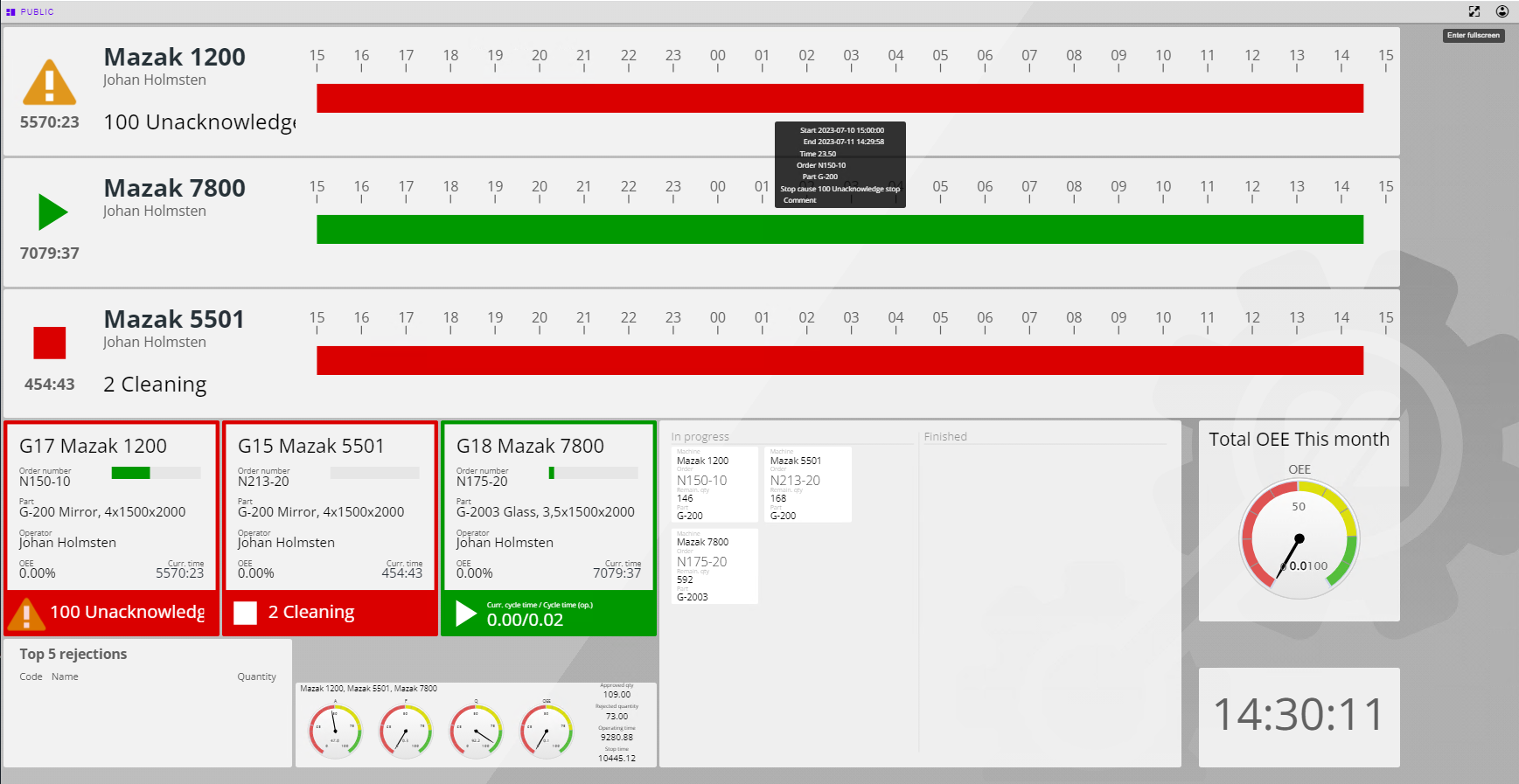
MI also has a web-based dashboard that can be configured however you would like. You use the dashboard to quickly get an overview of your machinery. You can display current status of the machines, view current OEE values, see which orders are being produced right now and their status, etc. When configured, you can show this dashboard on different screens in your factory.
MI Reports is a web-based report tool where you easily can create reports based on gathered data such as stops, run time, setup, rejections, manufactured quantity, OEE, setup time, cycle time, etc., to be used as follow-up and basis for decisions.
If there is a high level of automation, it is important to follow-up on stop times and machine usage.
MI helps you with:
- Stops are reported automatically by the machine – The operator selects a stop cause and you can also follow up on on-duty time to the machine.
- Quantity is continuously reported by the machine – Manual quantity counts and reporting is no longer required.
- Follow-up of pace and planned finish time – You can get an overview of your machinery’s status and use a tempo board. You get a clear, visual machine monitoring.
What are the benefits?
There are multiple benefits of using MI:
- More accurate reporting
- Reliable post-calculations (profitable/non-profitable products)
- Reducted and more straight-forward manual reporting for operators
- Improved machine monitoring
- OEE reporting
- Improved control of total profitability
The technology behind it
For each machine, a PLC should be linked (see illustration below), or an OPC, to interpret the signal from the machine and then report to Monitor ERP. One signal indicates that the machine is running, and another one that a piece is finished.
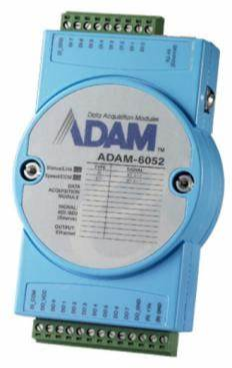
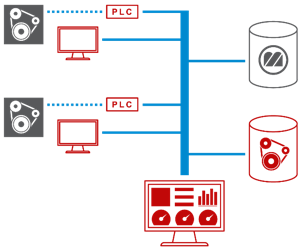
In addition to the PLC or OPC, you also need an MI server and one machine terminal per machine (marked red in the illustration to the left). You can then connect as many dashboards as you wish (the red screen with a diagram).
When is PLC or OPC the best choice?
Whether you should use PLC or OPC to gather data depends on a number of factors. OPC enables you to gather data for more than operational status, details produced, rejections etc. With OPC you can also gather external measurements such as temperature, power consumption, grip strength etc. These measurements can then be used to create BI solutions for e.g. finding out what the temperature was at a certain point of an order. You are also able to see exactly what the grip strength was on a particular detail produced. The possibilities are there! This does however put more demand on you as a customer using an OPC as you need to set up and implement an OPC solution that MI can connect to. A PLC is easier to manage with an electrician.
How can I get up and running?
Contact our sales department if you are interested in MI and they will help you get started. A pre-study by one of our consultants may be necessary to see whether MI suits your business.
This option has its own online help. Click here to be redirected to it.